A little while ago I took a hiatus from logistics and tried my hand at marketing and branding. I left that world broke and mostly broken — a consequence of burnout and a few other factors that eventually led me back to a pond I'm far more familiar with. Or should I say, warehouse.
One of the things I came to understand during that time is that the formula for content has fundamentally changed. I didn't set out to become a scholar on marketing history — I set out to run a business. That said, here's what I observed.
Rewind to the pre-internet, pre-social media era. If you wanted to get your idea out there, you had to contend with a very different set of circumstances. Say you wanted to promote a new snack brand. With a big enough budget and the right connections, you could get your promo on the radio, on TV, or in a newspaper. Yes, there were billboards and other formats — but if you wanted the eyeballs and ears of people at scale, those were the three channels that mattered.
It was a big investment on all fronts. Mad Men taught us all about the power of that model. And for those who could afford it, it worked.
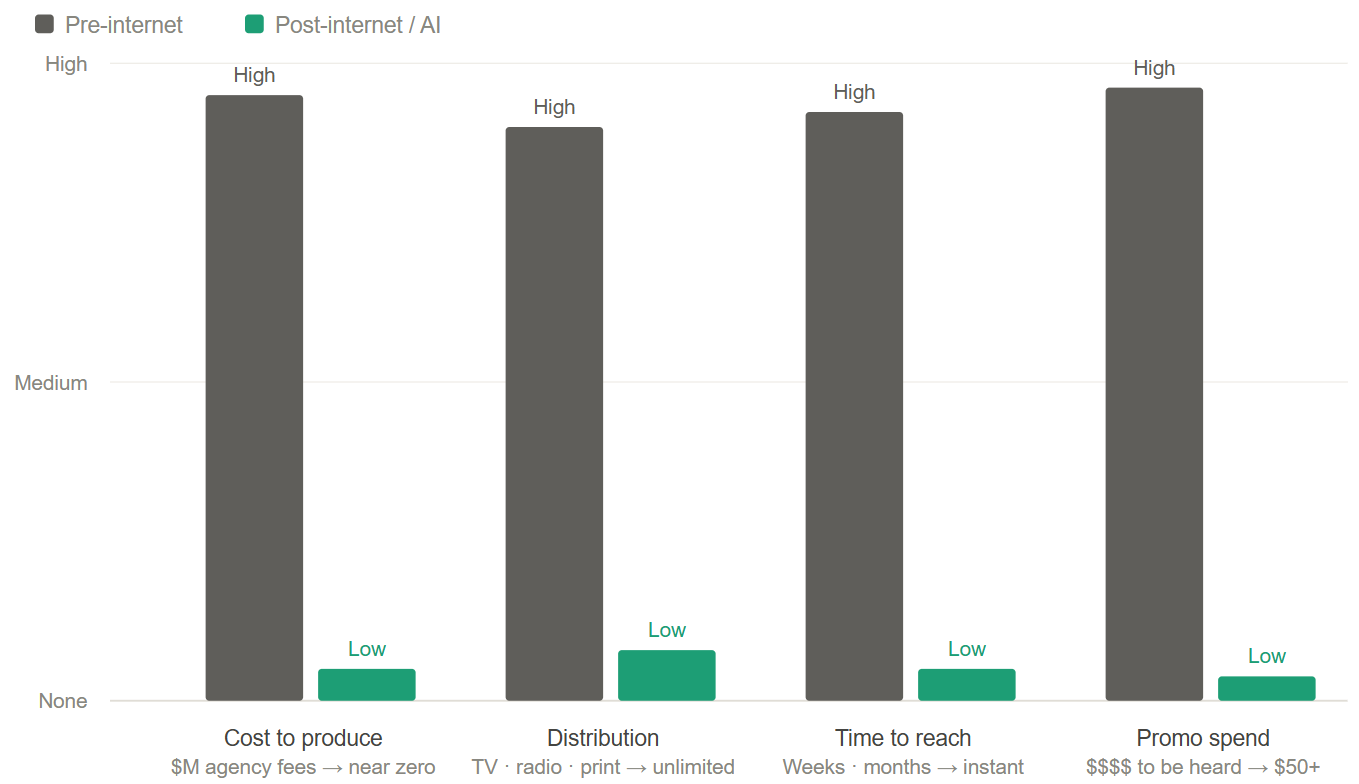
Fast forward and the circumstances have dramatically changed. On all four fronts — cost to produce, places to distribute, cost to promote, and reach — the barriers collapsed. The iPhone and a point of view could outperform a production budget.
Which brings me to YouTube, Star Wars, and two movies I have zero interest in ever watching.
Backrooms and Obsession are two films made by YouTubers in their twenties. One had a budget of around $1 million. The other around $10 million. Between them they've generated over $260 million at the global box office.
The Mandalorian and Grogu — for the record, Star Wars stopped for me after Rogue One — cost Disney $165 million to make and opened to its worst Star Wars performance in over a decade. So… make that 3 movies I will probably never see.
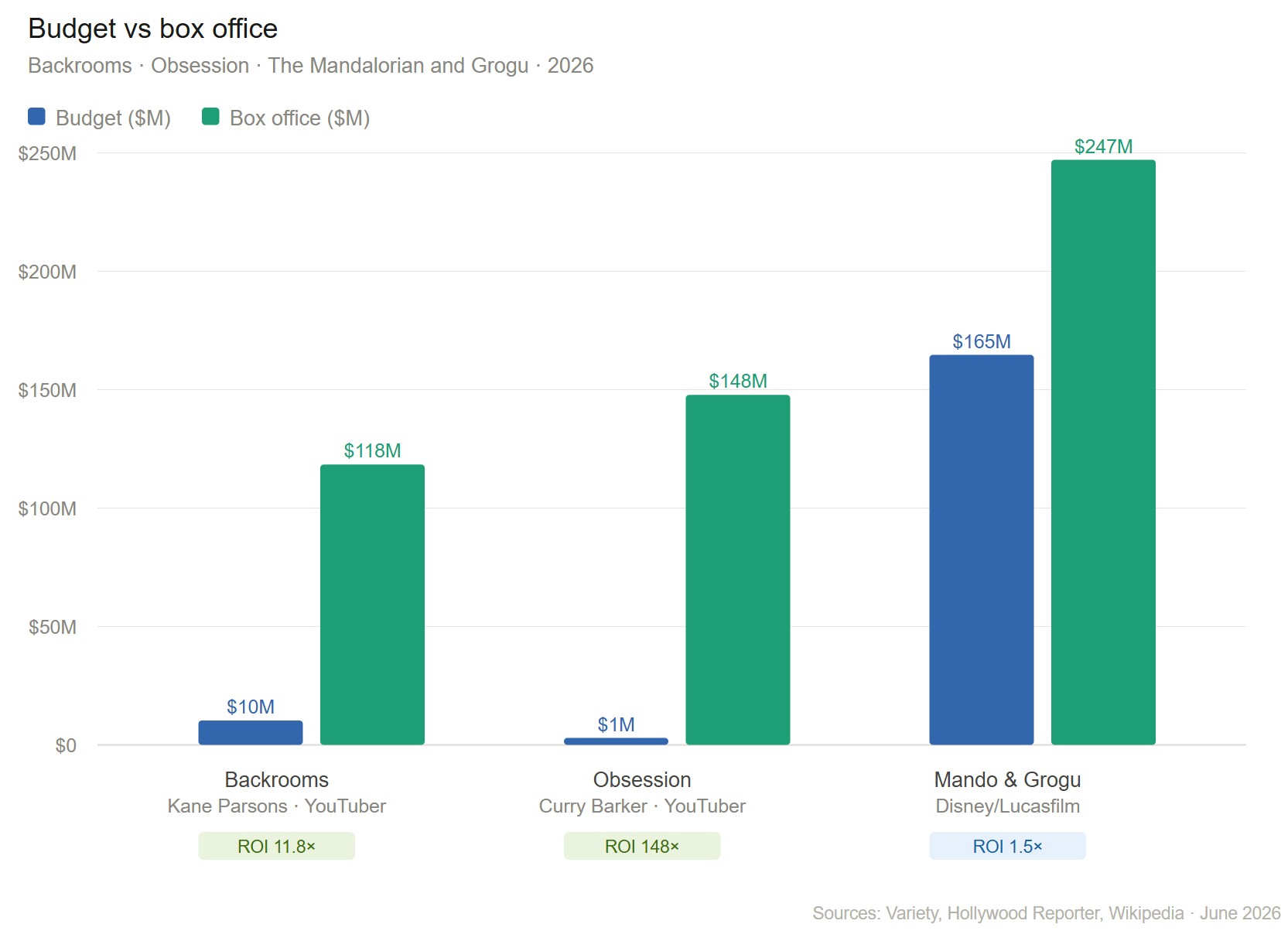
Despite me having no interest in any of these, the contrasting performance is stark. I don't think anyone had "YouTubers have a higher ROI for content than a Star Wars Movie" on their 2026 Bingo card. But here we are… the world's largest nerd franchise which, till the Disney takeover, could do no wrong — now beaten by a B-grade budget.
To be fair, Lucas didn't make anything for us to be angry about since Episode 3, but at least he didn't flood us with mid-tier-at-best nonsense being churned out of Burbank.
I've gone off topic, the point I'm making here is that an industry that used to have tall and hefty barriers to entry has been reshaped by widely distributed, easy-to-use tools that cost a fraction to access.
Now ask yourself the question - how is AI going to do the same to the world of operations?
Pre-AI, if you wanted to meaningfully organise and use information in your business, your options were roughly:
- Do it yourself
- Tell someone what you want them to do
- Use Excel
- Build something with developers
- Buy a system and go through an implementation
- More Excel
- Realise that options 2 through 6 are too difficult — and go back to option 1
The barriers were real. Time, cost, access to expertise, and team dependency all formed a hard ceiling on what was actually possible for most operations. Now though, you have access to the internet, mobile devices, and 20 years of system development that's been ingested by another system (AI) that's powerful enough to change the chart again. Making it look something like this:
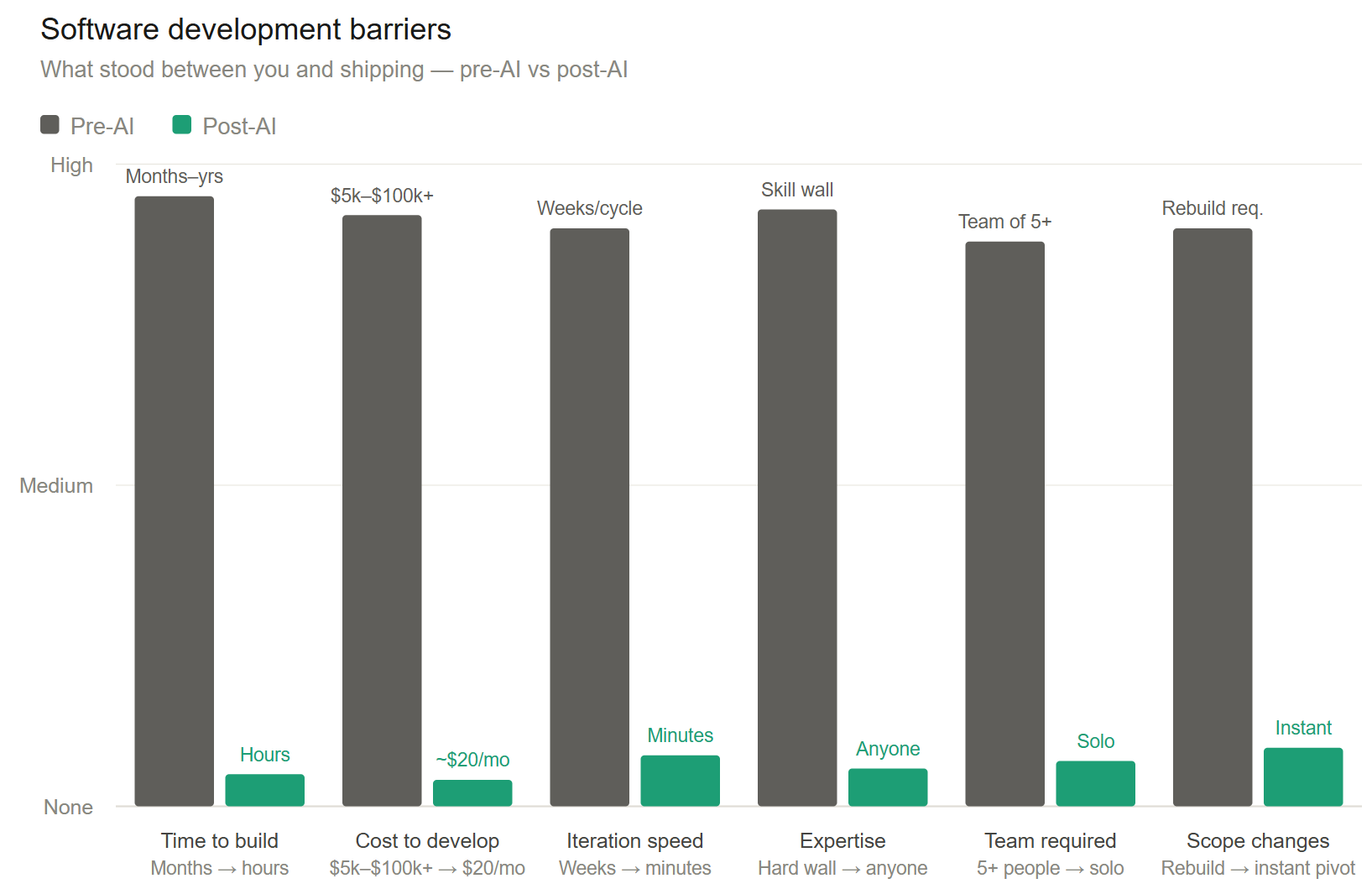
That ceiling has been removed. On all six fronts, the constraints that defined what was possible yesterday are not the constraints of today. The tools are widely distributed, accessible to anyone, and cost roughly what you'd spend on a lunch.
The question is no longer whether the moat is gone. It is. The question is what you build now that it is.
More on that next time.
The insights, frameworks, and opinions shared here are entirely my own and do not represent the views of any past or present employer.