A note on how this post was produced: spoken aloud, Googled for the sandbox definition, converted to a blog post with Claude, graphics made in Gemini. I thought I'd try something different — because I'm short on time. Which, as it happens, is exactly what this post is about.
I've been thinking about AI as a sandbox.
In nerd talk — so what someone from IT would say — a sandbox is an isolated testing environment where developers experiment without affecting anything live. It mimics the real thing, but nothing you do in it causes consequences in the real world.
Translated into English: you test things without risking things.
Chances are you're already using AI as a sandbox — you just haven't called it that. The email rewrite before you hit send. The what-if on the spreadsheet. The tone check before the difficult conversation in person. Low stakes, fast feedback, no consequences.
But what if you went a step further?
What if AI could help you develop ideas that are genuinely abstract — the ones that aren't fully formed yet, where you don't even know the right questions to ask?
Here's an example. You're running a warehouse and you want to improve how efficiently you pick orders. There are plenty of ways to approach this problem — changing your layout, optimising your systems, developing your pick profile, implementing pick zones. The list grows and shifts depending on your circumstances, your volumes, your team, your constraints.
This is exactly the kind of problem where a large company would bring in a consultancy. They come in, assess, recommend. At the end you have a PowerPoint deck, a list of actions, and the satisfying feeling of having done something about it.
That feeling usually comes with a very large invoice.
What if you could get to a similar starting point — the clarity, the direction, the right questions — before any of that? What if you could take your problem, describe it in whatever language you're most comfortable with — writing, voice notes, spreadsheets, even a photo of your warehouse floor — upload it to an AI, and start working through your problems without needing to know the target outcome is, to use AI for exploration before the expense.
Not instead of the consultant. Before the consultant.
The process of doing this doesn't just help you think — it helps you translate the vague and uncomfortable unknown into something tangible. And tangible means you know what questions to ask next, which means you know who you need to talk to next.
Think of it like this. You think you need a bigger warehouse.
You open Claude, ChatGPT, or Gemini and type: "I think I need a bigger warehouse. As my expert-level logistics consultant, advise me on this idea and what I should consider doing next."
Here's what I got from Gemini when I typed that in:
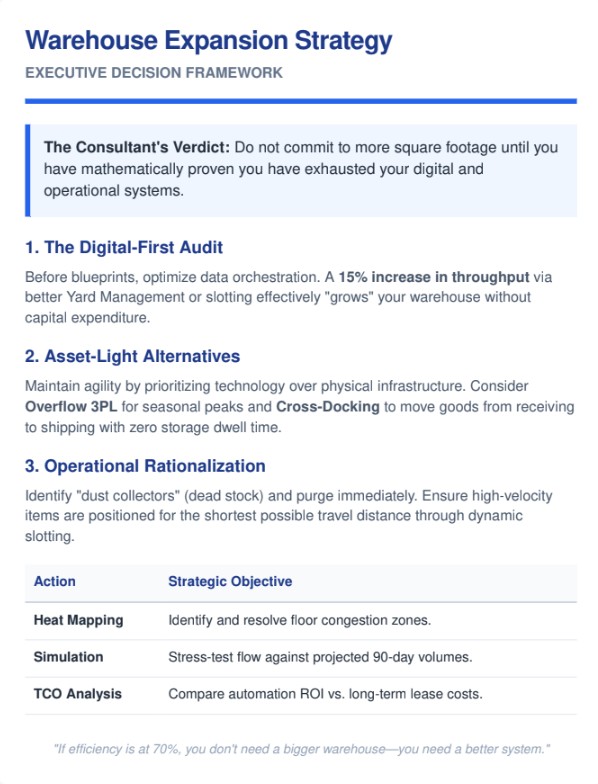
For those listening, you can find this image part of the write up of this post. But I'll describe what was created. I received 3 steps: 1) a digital-first audit, 2) a description of asset-light alternatives, 3) a point about dead stock. Followed by three actions around heat mapping, volume simulation, and a point about exploring automation.
One prompt in and I have a clear direction of where to start. That's the sandbox at work.
Today's top tip: when you don't know what to do, ask your AI first. Do your own prompting, prodding, and research. Then take what you've learned to your network and go deeper.
There are only two outcomes to trying this:
- You gain the clarity you need for your problem.
- You find out you still don't know what to do — in which case you definitely need to find someone to help.
Either way, you've made progress.
More on that next time.
The insights, frameworks, and opinions shared here are entirely my own and do not represent the views of any past or present employer.