Imagine a machine that's smart enough to take in all of your preferences, understand your professional relationships, knows what needs doing and in what order and does it without question.
The above is two things: first, it’s a description of middle management. It's not the frontline work of picking up pallets or stacking boxes and it's not the high level relationship management that you get to do in senior, it's the stuff between the top and bottom that gets neatly shovelled into the middle. Secondly, it sounds like a job for an AI.
Depending on how nihilistic you're feeling, the concept of replacing people with machines (in the information handling arena) is something you can see either moderately affecting your people or something with the potential to finally replace all of your people.
The reasoning behind cutting out middle management is pretty straightforward, if one can do the 'thinking' then direct a trained machine to execute thy bidding. Stuff like coordinating rosters, dealing with customer enquiries, or planning the next day's operations. If a machine can do all of that, I can do whatever I want, bank the salary as I save for a new 3 Series.
But if you have a soul you're probably not looking at Jenny who's worked with you for ten years and thought - how do I get rid of her? Sure BMW drivers may be pathologically incapable of using indicators but even they don't wonder how the office would be better if it were empty.
Besides, Jenny is the one you get to gossip with at lunch and when you're actually doing work she's a fantastic professional that knows the law as well as which sites have work to be done and how to actually get things across the line.
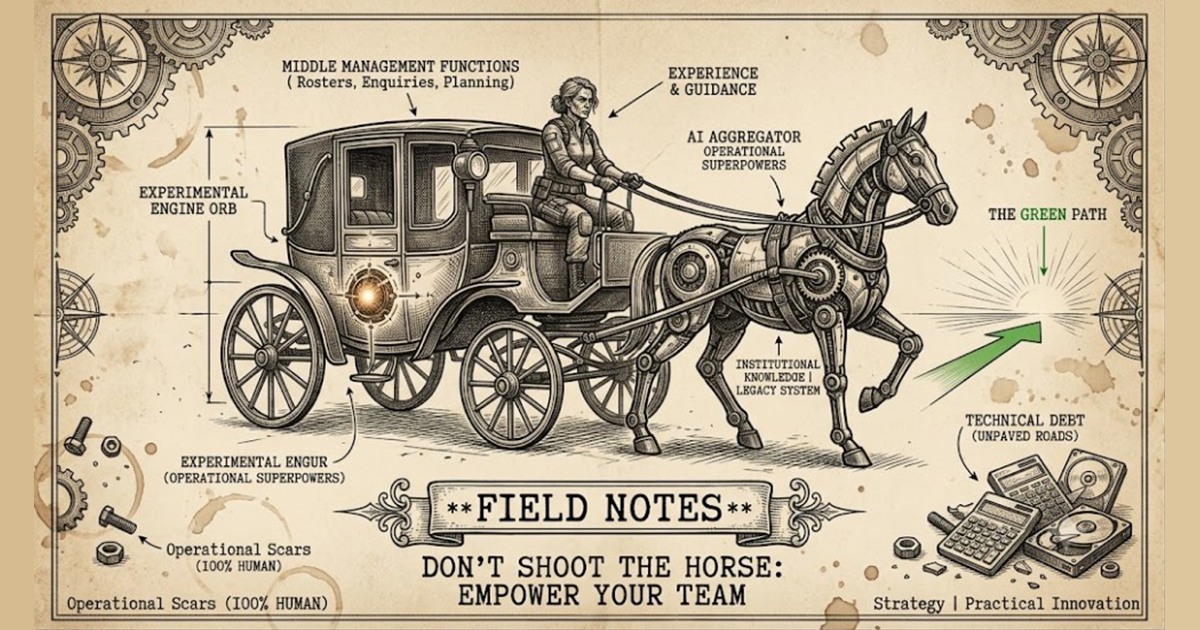
Getting rid of Jenny would be like shooting a horse because you bought a car before there were paved roads to drive it on. Objectively, yes, the future is here and you should embrace it. Realistically though… you should probably take your time learning how to drive before Jenny retires.
If you're in the Australian market, you know that finding and hiring good people is harder and more expensive than ever. Especially when you don't really know what good looks like in "a dynamic fast-paced and ever changing environment".
Typically, you end up with three options: 1) hire through an agency, 2) pay more, 3) train the people you already have. With AI I propose you have a fourth option: give Jenny more power.
I propose that what's more powerful than doing more with less is taking what you have and doing more.
How do you use the tools and technology at hand to get more done, to go from surviving to thriving by unlocking two keys to creativity in the workplace: time and space.
The idea of cutting out middle management might make short-term sense, but let me suggest that instead of looking at how to be rid of your teams you look at this as a new era in innovation and progress.
As mentioned, the constraints to creativity have been largely locked up in the information age, behind tall barriers of complexity, coding aptitude, and costs of many kinds. To summarise and reiterate this: we now have building blocks which past generations never did.
We have connectivity (the internet), portability (mobile devices), functioning roads (unless you're in Victoria where we specialise in potholes), literal power (electrical grids), and now of course a tool to aggregate, infer, and extrapolate meaningful information with accompanying actions (AI).
You've never had a better chance than now to empower Jenny to build something that lasts beyond her. Except the potholes… can't do much about that.
What does good look like?
A profitable, happy, productive operation that delivers your promises to customers. A team with the time (because an AI setup is helping do the boring bits which you no longer have to), and space (both literal and also abstract in the pursuit of ideas unproven because they were conceived on a whim at lunch).
Is some of this fantasy? Of course. But what's harder than pointing out problems (which anyone can do) is to look ahead and try to find the green path. I've found this quite productive lately, rather than dwell on what could go wrong, build for good, aim for good. Maybe even great.
This started off by discussing the permanent exit of middle management. I leave you with, hopefully, a way to look at what you're doing and ask "how can we do that better - together".
This ended a lot cheesier than I expected… but, the point sticks. Besides, who doesn't like cheese.
The insights, frameworks, and opinions shared here are entirely my own and do not represent the views of any past or present employer.