I've been in logistics since becoming a cadet on March 5th 2012. That's long enough to have developed a strong but slightly strange affection for forklifts, racking, and to an extent for a particular brand of kind of chaos that you can only find on a loading dock at 6am.
Around for long enough to need a break.
Which I did, in 2020 I left to start a marketing business called Storytime Studios. I ran it for few years and was so not-successful and unsatisfied that I came back to my original beloved racking, forklifts, and systems.
The reason I came back — one of them, anyway — is that running your own business is by far the most stressful thing in the world. Not only are you solely responsible for every single problem ever, you have no support (because that costs money), no resources (because you don't have any money), and when you finally have some money, it gets eaten by operational costs, marketing fees, material costs and of course the government who will take their cut before you've had a chance to feel good about it or anything you've done.
The thing that burns out most operators of enterprises big and small, myself being no exception, isn't the money. It's the fact that you have to do everything yourself.
Every email. Every problem. Every good client. Every horrible one. Every invoice, every empty bank account, every sales conversation where you're simultaneously the product and the salesperson. You have so much to do that the idea of teaching someone else — after you've spent the week burning through your mind's glucose — is not as appealing as pouring a G&T and trying to calm down before the next round of bedlam.
Being at the centre of everything sounds heroic. It's how we see heroes in movies and TV shows, like in that Michael Jordan documentary. But business doesn't stop at the buzzer. It never calls time. And with each minute spent fixing without teaching, without documenting, without handing over — you're not just solving the problem in front of you. You're adding to a pile that keeps growing while you sleep.
The debt you're not counting
That pile has a name. Three names, actually.
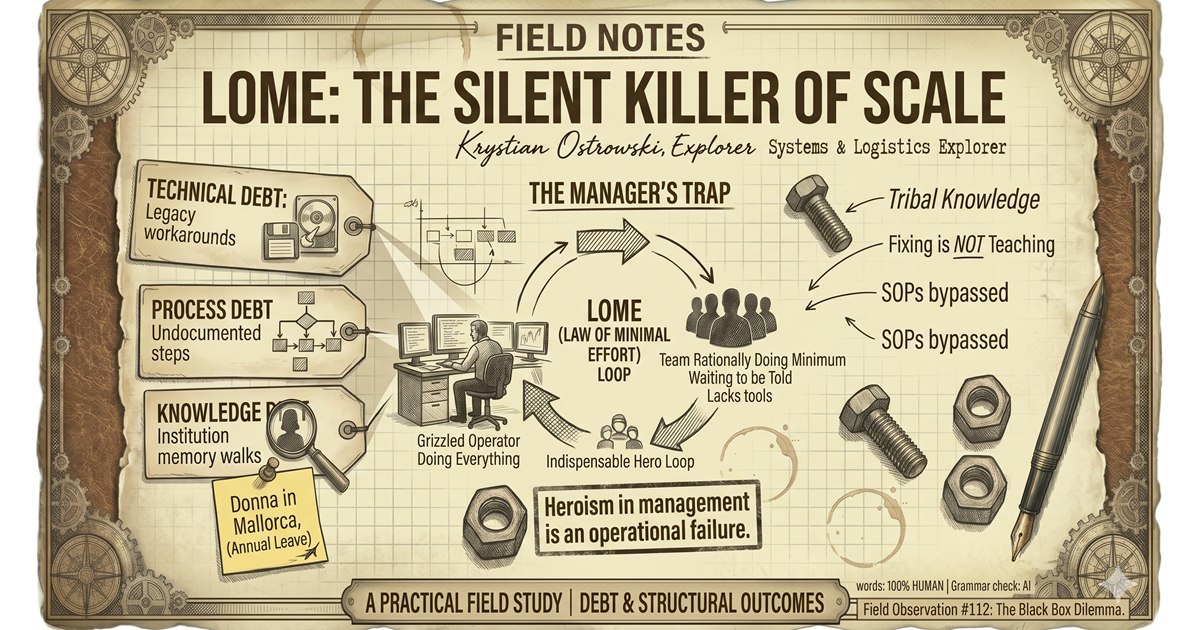
Technical debt is maintaining ways of working that were built for a different time, a different scale, a different problem.
The classic example: a customer's discount hard-coded into an invoicing script instead of sitting in a rates table where it belongs. It works until it doesn't. And when it breaks, nobody remembers why it was built that way — because the person who built it was too busy to write it down. Another example is having a number hardcoded in a specific cell in a spreadsheet instead of being linked to a source.
Process debt is the gap between how something is designed to work and how it actually gets done. The software has a feature but the team using the system doesn't know it exists, doesn’t trust it, or tried it once and it didn't quite work. So they do it manually. Every time.
The manual steps become the process.
The process becomes invisible. A shadow process. Which, eventually nobody questions because "that's the way it's always been done". (We'll talk more about this in another post).
Knowledge debt is Donna. Specifically it's the invoice that didn't go out in August because Donna is in Mallorca (Donna gets paid very well).
It's the customer who only gets called back on Thursdays because that's when a Donna knows to call. It's the institutional memory, the tribal knowledge on the DC floor that walks out the door with every resignation, every redundancy, every person who left before anyone thought to ask what they actually knew.
The manager (me) which I described at the start — the one doing everything, the one the whole operation quietly orbits — is usually carrying and adding to all three of these debts. Not because they want to but because there's never time to do things differently.
Why LOME makes it permanent
This is where things compounds.
LOME or The Law of Minimal Effort is what happens to everyone around that manager. Not out of laziness, and not always out of spite. But when there's no documentation, no instruction, no context, and the person who knows what to do is already overwhelmed — the only rational response is to do the minimum. To wait to be told. To not go looking for a problem you don't have the tools to fix.
LOME isn't a character flaw. It's a structural outcome. The manager's knowledge debt creates the conditions for everyone else's minimal effort, which creates more knowledge debt, which makes the manager more indispensable, which leaves less time to document anything.
It's circular. And it keeps going until something breaks.
The debt doesn't announce itself. It accumulates quietly — in the script nobody touches, in the manual step nobody questions, in the Thursday phone call nobody else knows to make. And like any debt left unattended, the interest compounds until the balance is bigger than anyone wants to deal with.
Two questions worth asking
We now have AI tools that can take a PDF, a napkin scribble, a half-finished Word doc, and start piecing together your processes — and in some cases, running parts of them for you. That's genuinely useful. But before you get there, two questions will tell you more about the state of your operation:
1/ What do we do that isn't documented?
2/ The last time something broke when someone was on leave — what did you do?
Sit with those answers for a minute. That's where the debt lives.
Content Disclaimer: The insights, frameworks, and opinions shared on this profile are entirely my own and do not represent the views of any past or present employer.
Content Policy: I use AI to research and refine my writing, but the frameworks, ideas, and operational scars are 100% human unless stated otherwise.