Here's a fun fact: getting older has made me understand being angry.
Okay, I'm not that old, but I'm starting to understand why older people in the workforce are so frustrated with... well, a lot of things, but mainly with technology.
And you know what? They might have a point. Even I, the ever self-aggrandizing and never shy from a free boast millennial, will bemoaningly ponder: Why can't things be like they were? Why does all new music sound like garbage? Why do Tim Tams cost so damn much? Why is Justin Bieber still around? And why can't things at work just... work?
Bringing this up, you undoubtedly think to yourself: "But Krystian, which technical frustration are you talking about?" The dreaded Wi-Fi? Emails not working? Spreadsheets? Formulas? The "system"—which is always broken? Perhaps a failed digital transformation project that's cost double what was budgeted and taken three times as long?
The frustration is with AI. Not the fact that it's turned into a buzzword for everything done by anyone, anywhere—the same as "Boost" used to be, or "Smart" before that, and "Blockchain" ten seconds earlier. The frustration isn't a marketing department's hijacking and exaggeration of a particular application's abilities.
It's the fact that one day soon, I won't just have passing empathy for the "oldies." I will have genuine frustrations for things I don't control, don't understand, and that nobody ever took the time to explain to me.
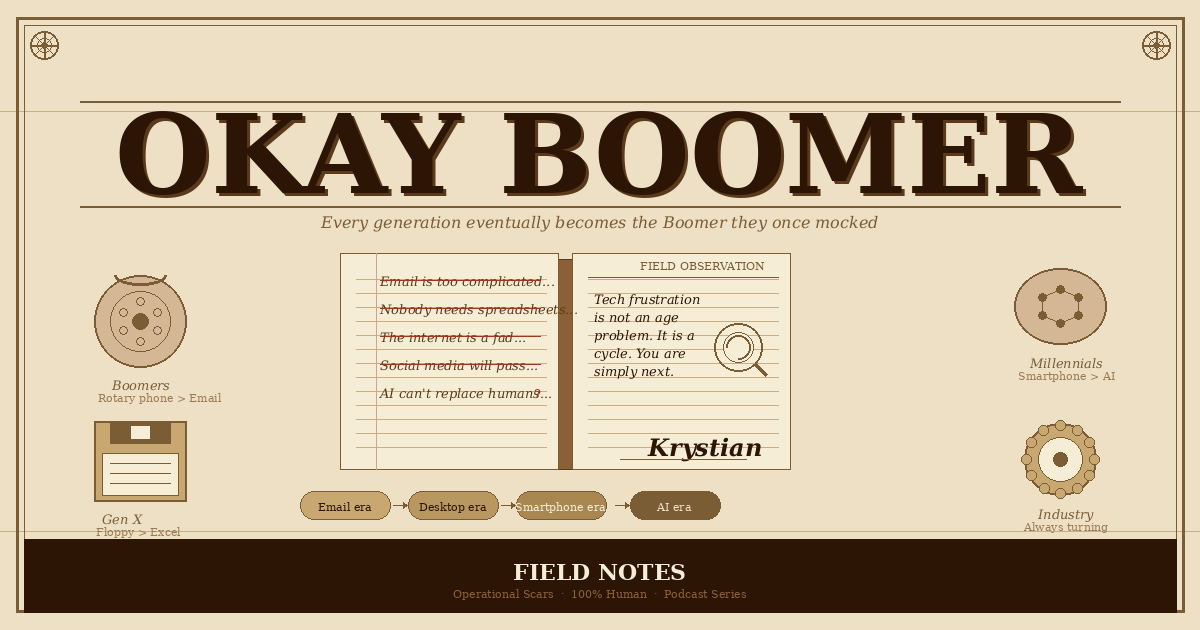
Think about it: every generation had its own "thing" to be frustrated with, try to figure out, and eventually master (or retire):
- Boomers had to work out fundamentals like email... and electricity.
- Gen X had to work out how to use spreadsheets.
- Millennials had to Google things and be the company's "social media young person."
Each preceding shift built the foundations for the next generation. Each generational technology had unknown applications and unrivalled opportunities that had never been seen before, along with personal consequences that were not fully foreseen.
Take millennials, who learned how to do "influencer speak" at the cost of their identity and soul, while Gen X had to work out how to use a SUM formula at the cost of their sanity. In the words of not-Harvey Dent: The only way to survive is to quit before you're outdated or see yourself become a Boomer.
Fun fact: Microsoft Excel has around 500 functions, but the average person uses between 5 and 25 of them.
Fun prediction: Millennials won't give up spreadsheets because they know how to control them. I would also like a large cash payment the first time one of my peers cries out: "Back in my day, we knew where our data came from AND how to format it, you Gen-A-Z-I turkey!"
Gen Z (and whatever the one after them is called) will have their own technology to master as they navigate the modern working world, and yes, they'll need to learn how to use AI. The opportunities are generational, and the cost is likely to be frighteningly loose relationships with psychopathic, human-sounding machines that make it hard to differentiate between facts and reality.
That's okay, though, because each generation helped the previous one figure things out—partly because the young 'uns see a Boomer's problem as easier to solve than strolling down the street. But mainly, it’s because we got nagged so much to fix things and post things and do things that we figured everything out and eventually took that person's job (also known as a promotion). The point being that, as much as we live in a world dedicated to division, working together to bring new and creative ideas to life is still the best way forward because it's the way we've done it for generations.
Where do we go from here? I don't really know; a Gen Z person hasn't shown me how to set up my AI to help me Google things.
Content Disclaimer: The insights, frameworks, and opinions shared on this profile are entirely my own and do not represent the views of any past or present employer.
Content Policy: I use AI to research and refine my writing, but the frameworks, ideas, and operational scars are 100% human unless stated otherwise.